Here is a draft for your Teenfounder post. It balances celebrating your wins with a transparent, relatable look at the engineering hurdles—exactly the kind of "building in public" content that communities love. ## 🚀 Building in Public: Big Upgrades to Core Stratagem (+ A Major Magic URL Fail) Hey everyone! I’ve been deep in the development trenches working on my project, **Core Stratagem**, and I wanted to share some massive updates I just shipped to the platform, along with a classic engineering reality check I ran into along the way. Here is a breakdown of what’s new, what actually works, and the feature I had to completely tear out. ## 🛠️ The New Features & How They Work I wanted to make the workspace feel less like a basic form and more like an advanced, real-time IDE for narrative generation. Here is what is officially live: | New Feature | What It Does (Function) | | :--- | :--- | | **🧠 Asset-Driven RAG Engine** | You can now drop in a lore map or plot binder (up to 5MB). The app splits, indexes, and stores it, automatically pulling context into the generation prompt so the AI never forgets your world-building rules. | | **📡 Layer 4 Telemetry Dashboard** | Gives live visual feedback on text generation quality. It tracks technical KPIs like phrase suppression efficiency, dialogue diversity percentages, lexical echoes (repeated words), and sentence pacing dynamic ranges. | | **📁 SQLite Secure Vault Explorer** | A persistent file history browser. Users can securely scan cloud storage, see past file sizes/timestamps in a neat data grid, and click an anchor to instantly re-mount a past writing session. | | **🔍 Event-Driven Token Analytics** | Instead of waiting for a crash mid-generation, the interface monitors the Gemini Developer Token box in real-time. It pings the validation cluster on change/blur to show a live status badge (Active, Exhausted, or Invalid). | ## 🛑 The "Magic URL" Failure: A Lesson in Overengineering Now for the part where things broke. 😅 I wanted to implement a **"Magic URL Bypass"** feature. The goal was to let alpha testers click a link with a query parameter (like ?access=token&user=Kristy) to completely skip the login screen and load right into their custom workspace. ### What went wrong: 1. **State Desynchronization:** Passing global URL strings into Gradio’s state system to dynamically toggle UI component visibility created a massive headache. If a user refreshed or inputted variables too quickly, the rendering thread would lock up. 2. **Tuple Return Mismatch:** My event-driven token checker was trying to pass information to the wrong interface hooks, causing an immediate runtime crash when the space first spun up. 3. **The realization:** I spent hours writing complex security bypasses, token validation guards, and manual session-tracking logic only to realize I was fixing a problem that didn't need to exist. > **The Pivot:** I decided to kill the magic URL code entirely and return to standard ground. I stripped out the custom bypass toggles and reverted back to Gradio's native auth= architecture. It naturally secures the app before compilation and securely reads user handles straight from the browser request headers (gr.Request). Cleaner code, zero runtime errors, and much tighter security. > ## 💡 Takeaway Sometimes the best engineering decision is knowing when to hit undo. Trying to build a custom login bypass taught me a ton about how web hooks pass data, but simpler is almost always better. The studio is now incredibly stable, fast, and packed with telemetry data! Would love to hear how you handle authentication layouts in your own Python web apps! Below is my Ul upgrades I have upgraded the Ul to be interactive and also added a bundle system so that the user can use which type of Al system he wants for his prose
Post Details

Abheejit Deka
@devilgod
Here is a draft for your Teenfounder post. It balances celebrating your wins with a transparent, relatable look at the engineering hurdles—exactly the kind of "building in public" content that communities love.
## 🚀 Building in Public: Big Upgrades to Core Stratagem (+ A Major Magic URL Fail)
Hey everyone! I’ve been deep in the development trenches working on my project, Core Stratagem, and I wanted to share some massive updates I just shipped to the platform, along with a classic engineering reality check I ran into along the way.
Here is a breakdown of what’s new, what actually works, and the feature I had to completely tear out.
## 🛠️ The New Features & How They Work
I wanted to make the workspace feel less like a basic form and more like an advanced, real-time IDE for narrative generation. Here is what is officially live:
| New Feature | What It Does (Function) |
| :--- | :--- |
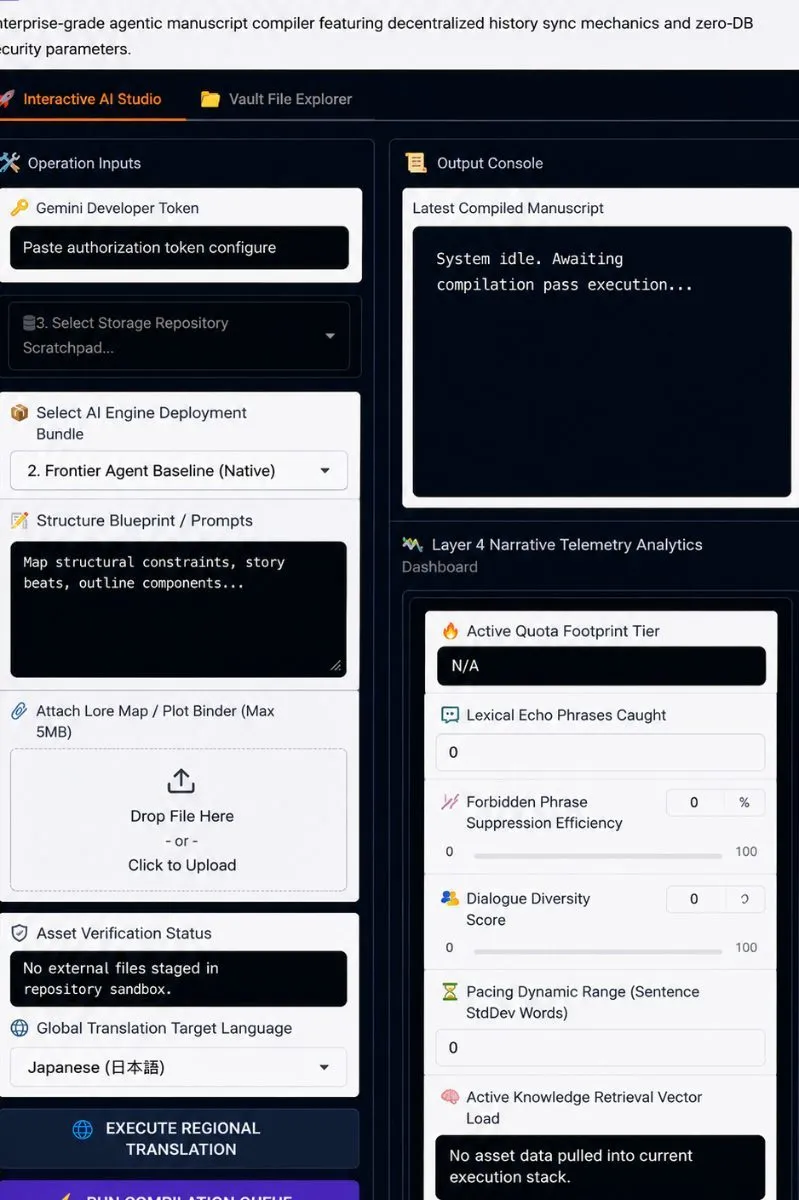
| 🧠 Asset-Driven RAG Engine | You can now drop in a lore map or plot binder (up to 5MB). The app splits, indexes, and stores it, automatically pulling context into the generation prompt so the AI never forgets your world-building rules. |
| 📡 Layer 4 Telemetry Dashboard | Gives live visual feedback on text generation quality. It tracks technical KPIs like phrase suppression efficiency, dialogue diversity percentages, lexical echoes (repeated words), and sentence pacing dynamic ranges. |
| 📁 SQLite Secure Vault Explorer | A persistent file history browser. Users can securely scan cloud storage, see past file sizes/timestamps in a neat data grid, and click an anchor to instantly re-mount a past writing session. |
| 🔍 Event-Driven Token Analytics | Instead of waiting for a crash mid-generation, the interface monitors the Gemini Developer Token box in real-time. It pings the validation cluster on change/blur to show a live status badge (Active, Exhausted, or Invalid). |
## 🛑 The "Magic URL" Failure: A Lesson in Overengineering
Now for the part where things broke. 😅
I wanted to implement a "Magic URL Bypass" feature. The goal was to let alpha testers click a link with a query parameter (like ?access=token&user=Kristy) to completely skip the login screen and load right into their custom workspace.
### What went wrong:
1. State Desynchronization: Passing global URL strings into Gradio’s state system to dynamically toggle UI component visibility created a massive headache. If a user refreshed or inputted variables too quickly, the rendering thread would lock up.
2. Tuple Return Mismatch: My event-driven token checker was trying to pass information to the wrong interface hooks, causing an immediate runtime crash when the space first spun up.
3. The realization: I spent hours writing complex security bypasses, token validation guards, and manual session-tracking logic only to realize I was fixing a problem that didn't need to exist.
> The Pivot: I decided to kill the magic URL code entirely and return to standard ground. I stripped out the custom bypass toggles and reverted back to Gradio's native auth= architecture. It naturally secures the app before compilation and securely reads user handles straight from the browser request headers (gr.Request). Cleaner code, zero runtime errors, and much tighter security.
>
## 💡 Takeaway
Sometimes the best engineering decision is knowing when to hit undo. Trying to build a custom login bypass taught me a ton about how web hooks pass data, but simpler is almost always better.
The studio is now incredibly stable, fast, and packed with telemetry data! Would love to hear how you handle authentication layouts in your own Python web apps!
Below is my Ul upgrades I have upgraded the Ul to be interactive and also added a bundle system so that the user can use which type of Al system he wants for his prose
## 🚀 Building in Public: Big Upgrades to Core Stratagem (+ A Major Magic URL Fail)
Hey everyone! I’ve been deep in the development trenches working on my project, Core Stratagem, and I wanted to share some massive updates I just shipped to the platform, along with a classic engineering reality check I ran into along the way.
Here is a breakdown of what’s new, what actually works, and the feature I had to completely tear out.
## 🛠️ The New Features & How They Work
I wanted to make the workspace feel less like a basic form and more like an advanced, real-time IDE for narrative generation. Here is what is officially live:
| New Feature | What It Does (Function) |
| :--- | :--- |
| 🧠 Asset-Driven RAG Engine | You can now drop in a lore map or plot binder (up to 5MB). The app splits, indexes, and stores it, automatically pulling context into the generation prompt so the AI never forgets your world-building rules. |
| 📡 Layer 4 Telemetry Dashboard | Gives live visual feedback on text generation quality. It tracks technical KPIs like phrase suppression efficiency, dialogue diversity percentages, lexical echoes (repeated words), and sentence pacing dynamic ranges. |
| 📁 SQLite Secure Vault Explorer | A persistent file history browser. Users can securely scan cloud storage, see past file sizes/timestamps in a neat data grid, and click an anchor to instantly re-mount a past writing session. |
| 🔍 Event-Driven Token Analytics | Instead of waiting for a crash mid-generation, the interface monitors the Gemini Developer Token box in real-time. It pings the validation cluster on change/blur to show a live status badge (Active, Exhausted, or Invalid). |
## 🛑 The "Magic URL" Failure: A Lesson in Overengineering
Now for the part where things broke. 😅
I wanted to implement a "Magic URL Bypass" feature. The goal was to let alpha testers click a link with a query parameter (like ?access=token&user=Kristy) to completely skip the login screen and load right into their custom workspace.
### What went wrong:
1. State Desynchronization: Passing global URL strings into Gradio’s state system to dynamically toggle UI component visibility created a massive headache. If a user refreshed or inputted variables too quickly, the rendering thread would lock up.
2. Tuple Return Mismatch: My event-driven token checker was trying to pass information to the wrong interface hooks, causing an immediate runtime crash when the space first spun up.
3. The realization: I spent hours writing complex security bypasses, token validation guards, and manual session-tracking logic only to realize I was fixing a problem that didn't need to exist.
> The Pivot: I decided to kill the magic URL code entirely and return to standard ground. I stripped out the custom bypass toggles and reverted back to Gradio's native auth= architecture. It naturally secures the app before compilation and securely reads user handles straight from the browser request headers (gr.Request). Cleaner code, zero runtime errors, and much tighter security.
>
## 💡 Takeaway
Sometimes the best engineering decision is knowing when to hit undo. Trying to build a custom login bypass taught me a ton about how web hooks pass data, but simpler is almost always better.
The studio is now incredibly stable, fast, and packed with telemetry data! Would love to hear how you handle authentication layouts in your own Python web apps!
Below is my Ul upgrades I have upgraded the Ul to be interactive and also added a bundle system so that the user can use which type of Al system he wants for his prose
5:50 AM · Jul 1, 2026
0
viewsLog in to join the conversation
Log in